Advertise With us

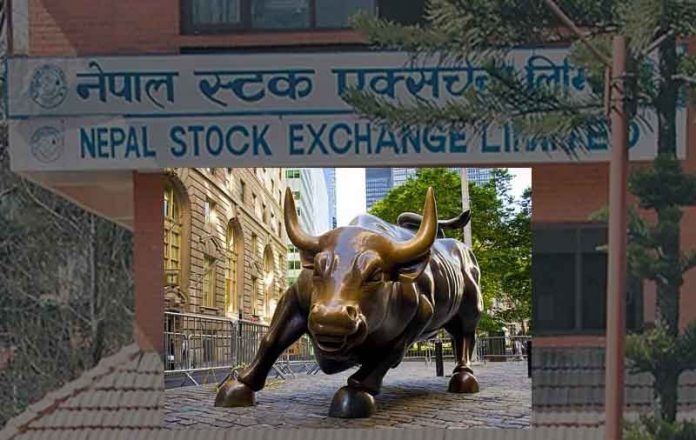

A stock market, equity market or share market is the aggregation of buyers and sellers of stocks, which represent ownership claims on businesses; these may include securities listed on a public stock exchange as well as those only traded privately.
SOMETIMES IT SEEMS NECESSARY TO SEE THE STOCK MARKET.
Nepal is home to some of the oldest civilizations on earth. In its current form as a country however, it remains quite young. The monarchy was only abolished in 2008, and the country remains mired in political uncertainty. However, like many of the markets we cover, underpinning that political uncertainty is a burgeoning population with a strong youth demographic. Please see the fact box below for basic facts about Nepal.
The economy of Nepal remains heavily dependent on agriculture and almost 70% of labour is focused on that sector. Exports, similarly are concentrated in a few key areas. See the figure below, which provides a breakdown on Nepal’s exports. GDP growth has been sluggish for most of Nepal’s history, with inflation persisting to be challenging given Nepal’s landlocked location and poor infrastructure. However, continued development of the tourism sector, hydropower, and infrastructure spending from government programs is expected to push average annual growth to 5% for the next decade. For an understanding of why we are bullish on the NEPSE and Nepal, check out our piece from last week, featuring Sharesansar’s managing director.
How you should invest your moneyin stock market .We are driven by the necessity that Nepal needs a new Investing culture. By knowledge advertisements lots of personal and retail investors we are being ready on the path to spread Mass Financial Literacy. We wish to spread basic Financial Literacy to as many people in the country as possible and we hope to reach 100,000 people by 2018. We do not sell any financial product or advice to buy any particular financial product. Our only focus is only to educate and help you to take informed decisions.
Unlike the rest of South Asia, the influence of British Common Law in Nepal has been voluntary and at the election of Nepal’s rulers over time. Nepal historically had a legal system that was informed and developed by Hindu beliefs; the only such legal system in the world as recently as early 2000. More recently however, Nepal has developed a series of its own constitutions after establishing itself as a republic 2008. The most recent constitution was fully ratified in 2015. Like most developing countries, the legal system looks great on paper, but that has limited application in a day-to-day context, where contacts and ‘rules of thumb’ are far more important. For a historical background on the legal system in Nepal, check out this link here. For a more current update on Nepal’s legal system, check out this link here. Our recommendation for Nepal would be that any business or investment made, is made on the basis of a strong insight and trust of your counterparty. It is better to not rely at all on the court system, than expect it to come to your aid.
NEPSE first began operation in 1997 and began electronic trading in 2007. Trading is still not automated and that creates several issues for reducing brokerage commissions and increasing liquidity. To get an in-depth overview of how the NEPSE functions, check out Sharesansar’s FAQ section here.
 The basic facts on the market, you can find below:
It is a surprisingly deep and liquid market (relatively speaking) for its size, opaqueness and lack of foreign investment (more on that later). It certainly took its time, but its praiseworthy that in 20 years since market inception, it is a legitimate well-functioning market that is a legitimate source of fund-raising for Nepali companies.
The basic facts on the market, you can find below:
It is a surprisingly deep and liquid market (relatively speaking) for its size, opaqueness and lack of foreign investment (more on that later). It certainly took its time, but its praiseworthy that in 20 years since market inception, it is a legitimate well-functioning market that is a legitimate source of fund-raising for Nepali companies.